This page has moved to the Defense Innovation Unit
You are being redirected to DIU.mil
This page has moved to the Defense Innovation Unit
You are being redirected to DIU.mil
We use cookies for analytics, to see our policy, please read our Privacy Policy.

Local entrepreneurs, developers, designers, and hackers from the academic, military, and commercial start-up communities worked to build and demonstrate product prototypes to counter commercial off-the-shelf, small, unmanned aerial systems (sUAS).
Validation also considered the level of demonstration, and the viability of bringing the solution to market.
Composed of a mixture of students from the Naval Postgraduate School and private civilians, this team developed a solution comprised of a machine learning application that detects sUAS acoustics and plots the system’s location based on a unique set of sound characteristics..
A team of students from Texas A&M, GigEmBytes created a modular platform that allows the creation of modules that can automatically analyze drone firmware for classes of vulnerabilities and store the found vulnerabilities, then automatically launch selected exploits against those drones.
Another mixed team made up of students from Texas A&M and the Army Research Lab, this team demonstrated a solution that uses a ground network of cameras to monitor the airspace and detect a sUAV using computer vision and machine learning algorithms.
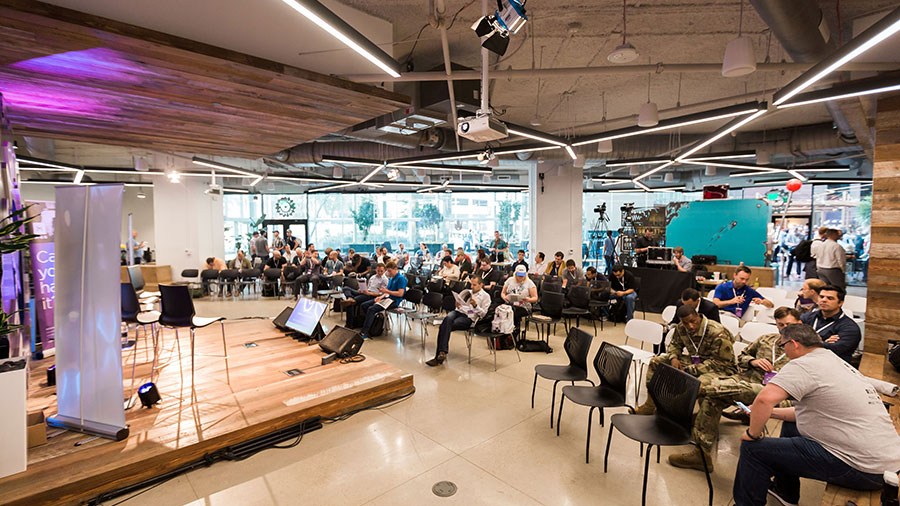
Each of the three winning teams will receive up to $15K project funding and mentoring from NSIN to advance their concepts. Beyond the winners selected, multiple teams developed concepts that the Army is interested in evaluating further.
For details on all the solutions, log onto https://a-hack-of-the-drones.devpost.com/.
Your browser is old and unsupported. You may still use the site, but functionality will be limited and you may see errors. Please consider updating your browser.